
For Students & Families
Everything you need for testing, etiquette, and being ready for class.
For details not covered below contact Paul Sensei directly.
Be Ready for Class – A quick checklist for students & parents
- Be on Time – all students should be changed and ready for training when the class begins. Students not on the mats for the starting bow are considered late.
- Uniform – should be washed regularly and kept clean for training
- Nails – short, smooth, and clean (clippers are available on-site)
- Hair – should be tied back (hair ties available on-site)
- Jewelry – earrings out; rings off. If earrings must stay in, cover with tape on-site
- Socks – train barefoot unless covering a cut; only clean, unworn socks or martial arts tabi allowed
- Towel & Water – bring a small hand towel (for yourself) and a water bottle
- School Uniform – school uniforms should not be worn under Aikido uniforms
- Undershirts/Base Layers – girls wear an undershirt; boys optional; base layers lightweight and snug
Keeping Clean in Aikido
I’d like to share a few small but important practices that help keep our training safe, respectful, and enjoyable. These guidelines are standard in martial arts and are especially important in Aikido, where training is almost always done with a partner.
Aikido is partner-based, so personal cleanliness and well-kept uniforms are essential. Staying clean shows respect for our partners and helps reduce the risk of injury or illness.
Cleanliness guidelines
Your Title Goes Here
Your content goes here. Edit or remove this text inline or in the module Content settings. You can also style every aspect of this content in the module Design settings and even apply custom CSS to this text in the module Advanced settings.
Aikido Uniforms
- Uniforms must be washed after use and completely dried before being packed for class.
- Families should check uniforms after each session so they are clean, dry, and fresh for the next class.
Fingernails and Toenails
- Nails must be kept short, smooth, and clean.
- Long nails can scratch a partner or get caught in uniforms, which can cause painful injuries.
- Nail clippers are available on-site at each location, but students should check and trim their nails at home before coming to practice.
Hair
- Long hair must be tied back before class begins.
- Soft elastics are best. Hard plastic or metal clips should not be worn, as they can cause injuries if bumped during practice.
- We keep hair ties on-site, but students should ideally come with their hair already tied back.
Jewelry
- Jewelry should not be worn during class.
- Earrings can get snagged in a partner’s uniform.
- Rings can pose a danger if stepped on, which can cut off circulation.
- If earrings must remain in, we have tape available on-site to cover them.
Your Title Goes Here
Your content goes here. Edit or remove this text inline or in the module Content settings. You can also style every aspect of this content in the module Design settings and even apply custom CSS to this text in the module Advanced settings.
Socks
- Students normally train barefoot to maintain safe contact with the mats.
- Socks may only be worn if there is a medical reason (for example, covering a cut, blister, or sore). In this case:
- Socks must be clean and unworn before class.
- Socks worn all day at school are not allowed, as they bring dirt onto the mats.
- Tabi (special martial arts split-toe socks) are the best option if foot covering is needed.
Hand Towels and Water Bottles
- Every student should bring a small hand towel and a water bottle to each class.
- The towel is for wiping their own face, hands, or body if they get sweaty (personal use only). This keeps them comfortable and prevents sweat from being transferred onto training partners.
- The water bottle is important so students can stay hydrated during practice. Please make sure bottles are filled before coming to class.
School Uniforms
- Students should not wear any part of their school uniforms under their Aikido uniforms.
Undershirts and Base Layers
- Girls should wear an undershirt beneath their Aikido tops. Please make sure one is packed on training days.
- Boys may wear an undershirt if they wish, but it is not required.
- Any undershirts, shorts, leggings, or similar items must be lightweight, snug-fitting, and breathable, so they do not restrict movement or cause overheating.
Track your progress toward the next test using the link below. Log in with the Gmail account you use to communicate with Pacific Aikido.
- Use the Google Chrome Browser, double-check that the account you’re logged in with matches the gmail account you use in your communications with Pacific Aikido.
- Don’t have a gmail account? No problem. Link your non-gmail account to a Google Account following these instructions.
- Seeing a blank report? Please contact Pacific Aikido for further assistance.
Pacific Aikido Testing Guidelines
Our testing guidelines follow those set by the Aikikai Foundation – Aikido World Headquarters. We have adapted certain elements to meet the needs of our programme, ensuring students meet the standards of training with Pacific Aikido—standards polished in over 30 years of instruction.
How Readiness is Determined
Your Title Goes Here
Your content goes here. Edit or remove this text inline or in the module Content settings. You can also style every aspect of this content in the module Design settings and even apply custom CSS to this text in the module Advanced settings.
Behavior On the Mats
This is the single most important factor in testing readiness.
It includes how a student conducts themselves in class, works with and supports their partners, and shows respect to both partners and instructors.
Are they focused or playing around? Are they training in a safe, responsible manner?
Students who disregard safety, behave inappropriately, or show poor attitude towards others will not be considered ready, regardless of technical skill.
Punctuality
Once students begin attending class independently (without a parent), they are expected to arrive on time. Arriving on time demonstrates commitment, maturity, and respect for both instructors and classmates.
The Pacific Aikido instructors believe that if a student can be regularly late, they can just as easily be regularly on time. Students who are consistently late will not be considered for testing until this issue is corrected.
Technical Skill
Everyone develops at their own pace.
Instructors work with each student to address specific areas that need improvement, ensuring they are confident and capable when testing day arrives.
Consistency In Attendance
Progress in Aikido is built on regular practice.
While missed classes can be made up, long breaks (two or three weeks) followed by catch-up sessions do not provide the same benefits as steady, consistent training.

All Pacific Aikido Dojos are officially recognized by the Aikikai Foundation-Aikido World Headquarters.
Tests are graded by Paul Sensei at the student’s regular place of practice. Once testing is successfully completed, applications are submitted to the World Headquarters (Hombu Dojo) where the certificates are produced.
Passing a test is more than earning a higher rank, it marks a significant step in a student’s Aikido journey. Passing students receive:
– Lifetime membership to the Aikido World Headquarters and member’s card following their first test.
– A certificate from the World Hedquarters
– A new coloured belt from Pacific Aikido (depending on the rank achieved)
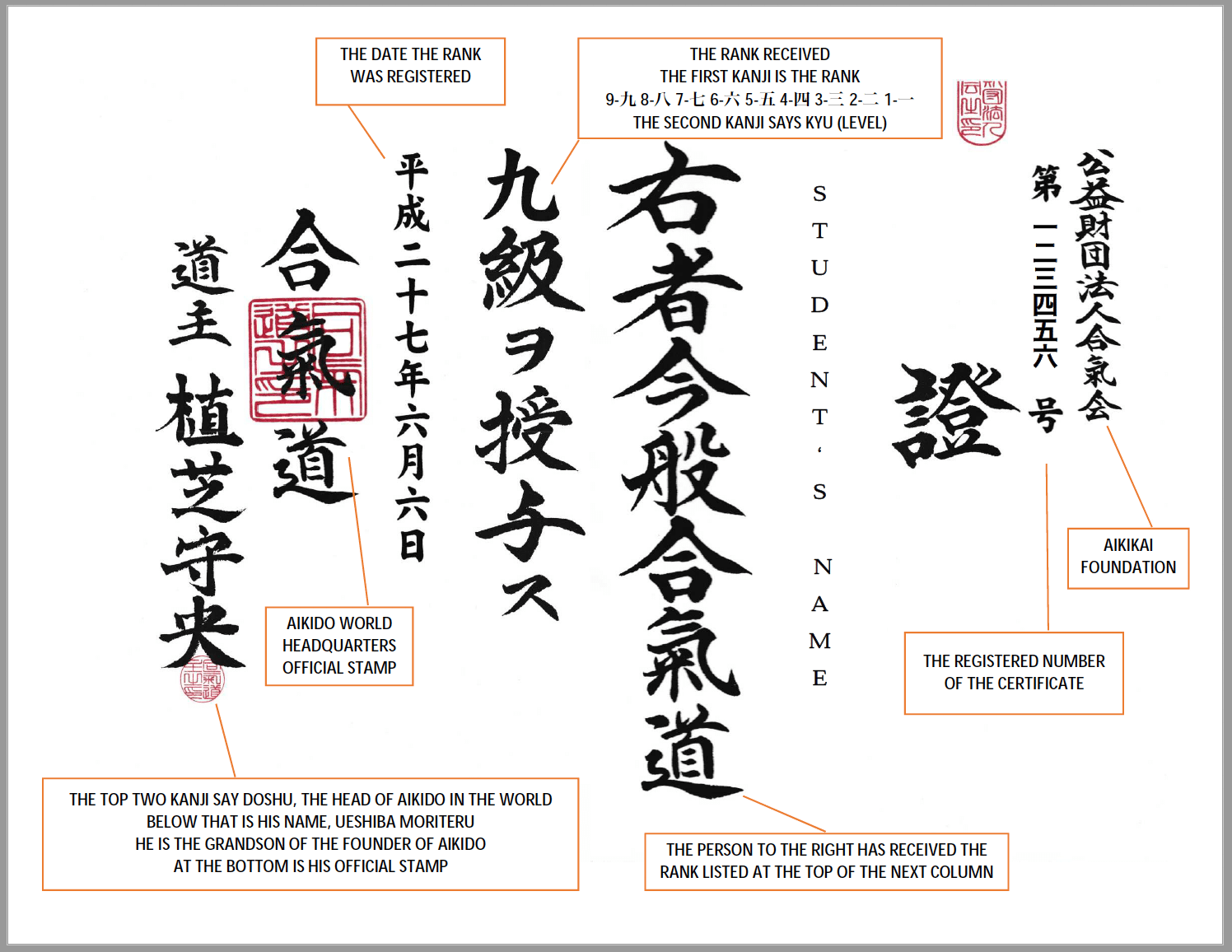
All students who pass their tests receive an official certificate from the Aikido World Headquarters confirming their new rank, which is officially registered with the World Headquarters, as shown on the translated form to the right.
Faq
Your Title Goes Here
Your content goes here. Edit or remove this text inline or in the module Content settings. You can also style every aspect of this content in the module Design settings and even apply custom CSS to this text in the module Advanced settings.
If I miss a class can I come to another class to make-up the time?
At the top of this page there is a link to the form you can fill out to reserve a place for a make-up class.